Offshore (or marine) geotechnical engineering is concerned with foundation design for human-made structures in the sea, away from the coastline (in opposition to onshore or nearshore engineering). Oil platforms, artificial islands and submarine pipelines are examples of such structures.
There are a number of significant differences between onshore and offshore geotechnical engineering. Notably, site investigation and ground improvement on the seabed are more expensive; the offshore structures are exposed to a wider range of geohazards; and the environmental and financial consequences are higher in case of failure. Offshore structures are exposed to various environmental loads, notably wind, waves and currents. These phenomena may affect the integrity or the serviceability of the structure and its foundation during its operational lifespan and need to be taken into account in offshore design.
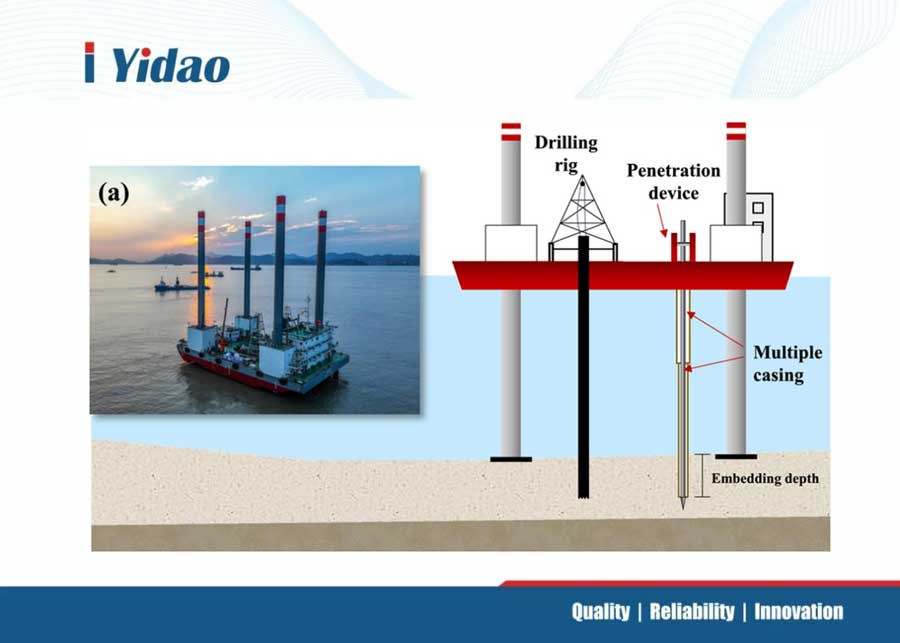
In subsea geotechnical engineering, seabed materials are considered a two-phase material composed of rock or mineral particles and water. Structures may be fixed in place in the seabed—as is the case for piers, jetties and fixed-bottom wind turbines—or may comprise a floating structure that remains roughly fixed relative to its geotechnical anchor point. Undersea mooring of human-engineered floating structures include a large number of offshore oil and gas platforms and, since 2008, a few floating wind turbines. Two common types of engineered design for anchoring floating structures include tension-leg and catenary loose mooring systems.
 BACK


